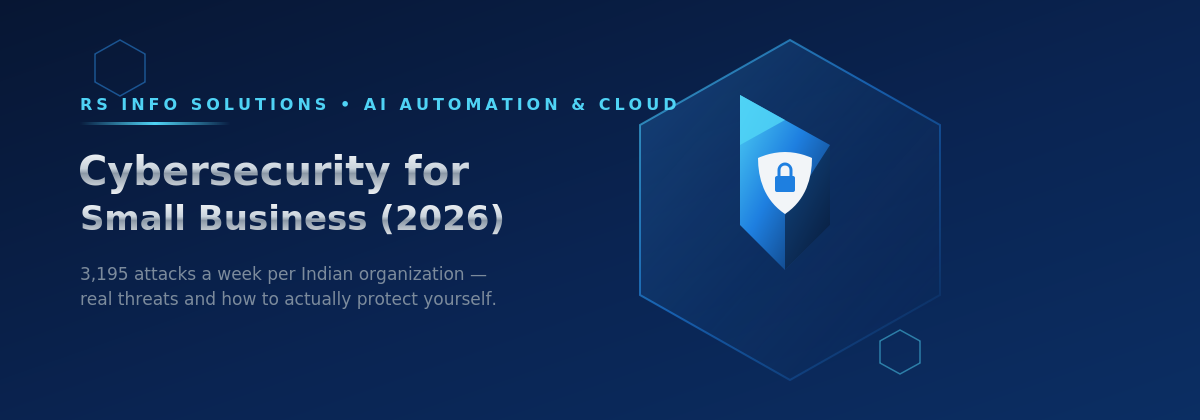
Cybersecurity for Small Business in India (2026): Real Threats and How to Protect Yourself
"We're too small to be a target" is the single most common — and most dangerous — assumption small business owners make about cybersecurity. The data says the opposite is true: Indian organizations now face an average of 3,195 cyberattacks per week, roughly 702 every minute, and small businesses are frequently the preferred target precisely because attackers assume weaker defenses and less awareness. Globally, 88% of small-business breaches now involve ransomware, compared to just 39% for large organizations — attackers aren't ignoring small businesses, they're disproportionately targeting them.
What's Actually Changed in 2026
Cybersecurity used to mean antivirus software and a firewall. That's no longer close to sufficient. Most attacks in 2026 don't involve traditional malware at all — the majority now rely on credential theft, social engineering, and legitimate remote-access tools rather than software an antivirus program would even detect. Practically, this means the biggest vulnerability in most small businesses today isn't a technical gap — it's a person clicking, approving, or trusting something they shouldn't.
AI Has Fundamentally Changed the Threat Landscape
AI-powered cyberattacks against small businesses rose by roughly 340% in the past year, with generative AI tools now behind a large majority of sophisticated social engineering campaigns. AI-generated phishing costs attackers a fraction of what traditional phishing used to cost to run, while achieving open rates several times higher than older, template-based attempts — the emails and messages simply read as far more convincing than they used to.
India specifically is seeing a distinct and genuinely alarming version of this: deepfake and voice-cloning fraud, where attackers impersonate CEOs, CFOs, or government officials using AI-generated voice recordings or video calls to authorize fraudulent financial transfers or extract credentials. Mid-sized Indian businesses are particularly exposed here, since the impersonation quality now regularly exceeds what standard security awareness training prepares employees to recognize. A recorded "urgent" voice message from your CEO isn't automatically your CEO anymore.
The Real Financial Stakes for a Small Business
- Small businesses report a cyberattack rate of roughly 49% annually, with incidents occurring at a genuinely constant pace.
- Average breach losses for a small business now approach $254,000 — a figure that can end a business outright, not just dent a budget.
- A significant share of businesses that suffer a serious attack close within six months of the incident.
- Despite this, nearly half of businesses with fewer than 50 employees allocate zero dedicated cybersecurity budget.
Prevention is dramatically cheaper than recovery — typical annual prevention spending for a small business runs a small fraction of the average cost of a single serious ransomware incident. This is one of the rare cases in business where the "wait and see" approach is measurably the more expensive path, not the cautious one.
Where Small Businesses Are Actually Getting Breached
- Phishing and email-based attacks remain the leading entry point, now supercharged by AI-generated messages that are far harder to visually distinguish from legitimate communication than older phishing attempts.
- Third-party and vendor risk — breaches originating through a SaaS platform, hosting provider, or managed service provider you rely on have roughly doubled year-over-year. Your security is only as strong as the weakest vendor in your stack, even when the breach didn't start in your own systems.
- Weak or reused credentials — with most attacks now credential-based rather than malware-based, a reused or weak password is frequently the entire attack surface an intruder needs.
- Ransomware — disproportionately a small-business problem, accounting for the large majority of SMB breaches specifically, versus a much smaller share for large enterprises with more mature defenses.
A Practical Security Checklist for Small Businesses
- Enable multi-factor authentication (MFA) everywhere it's available — email, banking portals, cloud storage, and any admin-level access. This single step blocks a large share of credential-based attacks outright.
- Use a password manager and unique passwords per service — reused passwords are one of the most common, and most avoidable, points of compromise.
- Train your team to verify unusual requests through a second channel — a call to confirm a voice message, a separate message to confirm an "urgent" email from a senior executive. With deepfake and voice-cloning fraud on the rise, verbal or video confirmation alone is no longer reliable proof of identity.
- Vet your vendors' security practices, not just your own — ask your hosting provider, SaaS tools, and any managed service provider what security certifications and practices they maintain.
- Keep software, plugins, and themes updated — particularly relevant for WordPress-based websites, where outdated plugins remain one of the most common vulnerabilities exploited.
- Back up your data regularly, and test that the backup actually restores — a backup that's never been tested isn't a real safety net against ransomware.
- Have a basic incident response plan written down before you need it — who to call, what to shut down first, and how to communicate with customers if something goes wrong.
- Budget specifically for cybersecurity, even a modest amount — given how disproportionately underfunded this remains among small businesses, a dedicated budget alone puts you ahead of a large share of your peers.
Website-Specific Security Priorities
If your website is a customer-facing asset (and for most businesses, it is), a few priorities matter more than the rest:
- SSL/HTTPS on every page, not just checkout or login pages.
- Regular plugin and CMS updates, since outdated software remains one of the single most exploited weaknesses on business websites.
- A web application firewall (WAF) to filter malicious traffic before it reaches your site.
- Limited admin access — only the people who genuinely need backend access should have it, and each should have their own credentials rather than a shared login.
- Regular automated backups stored separately from your live hosting environment.
5 Frequently Asked Questions About Small Business Cybersecurity
1. Are small businesses in India really at risk, or is this mostly a large-enterprise problem?
Small businesses are frequently a preferred target precisely because attackers assume weaker defenses. Indian organizations face thousands of attacks per week on average, and small businesses report nearly a 50% annual cyberattack rate globally — this is not a large-enterprise-only concern.
2. What's the single highest-impact security step a small business can take?
Enabling multi-factor authentication across email, banking, and admin-level accounts. With the majority of modern attacks relying on stolen or guessed credentials rather than malware, MFA alone blocks a large share of attempted breaches even when a password is compromised.
3. What is deepfake or voice-cloning fraud, and should a small business actually worry about it?
It's a growing fraud pattern where attackers use AI-generated voice or video to impersonate a executive or official and authorize a fraudulent transfer or request. Mid-sized Indian businesses are specifically noted as vulnerable, since the impersonation quality now often exceeds what standard training prepares staff to catch. The practical defense is simple: verify unusual financial requests through a second, independent channel before acting.
4. How much should a small business budget for cybersecurity?
Typical annual prevention spending for a small business is a small fraction of the average cost of a single serious breach — prevention is meaningfully cheaper than recovery. Even a modest, dedicated budget puts a business ahead of the large share of small businesses currently allocating nothing at all.
5. Is antivirus software still enough to protect a small business?
No — the majority of attacks in 2026 don't rely on traditional malware at all, instead using credential theft, social engineering, and legitimate remote-access tools that antivirus software isn't designed to catch. A layered approach — MFA, staff training, vendor vetting, and regular backups — is now necessary alongside any antivirus tool.
How RS Info Solutions Can Help
Most small business security gaps aren't exotic technical problems — they're a handful of unglamorous fundamentals left unaddressed: no MFA, outdated plugins, no tested backup, no verification process for unusual requests. We help set up the practical layer that actually stops the majority of real-world attacks: secured website infrastructure, WordPress and plugin maintenance, cloud security configuration, and a basic incident response plan tailored to your business, so you're not the business assuming you're too small to be a target.