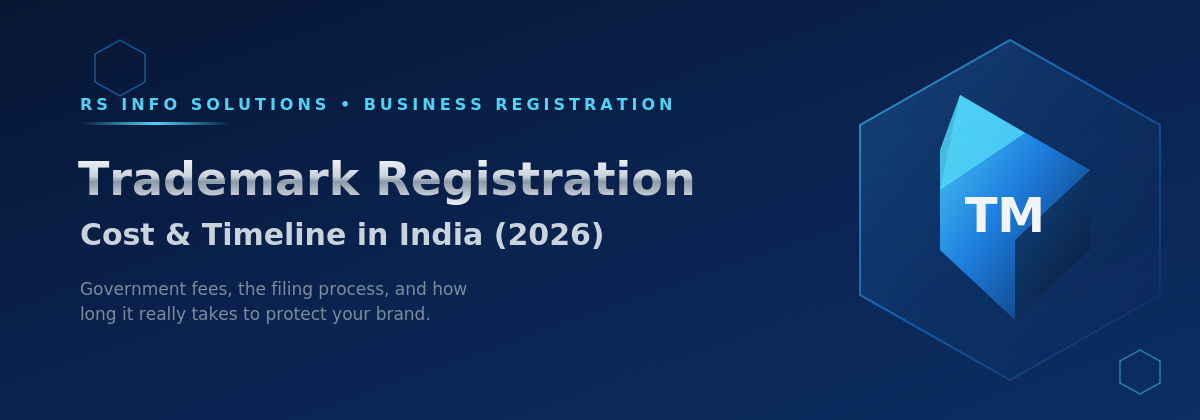
Trademark Registration Cost & Timeline in India (2026)
Your brand name is one of the few business assets that gets more valuable the longer you hold it — and in India, trademark rights generally go to whoever files first, not whoever used the name first. That single fact is why founders who wait "until the business is bigger" to register often end up fighting to keep the name they've already built a reputation around.
Here's exactly what trademark registration costs in 2026, how long it actually takes, and how the process works from search to certificate.
What a Trademark Actually Protects
A trademark protects your brand identity — the name, logo, slogan, or even a distinctive sound that separates you from competitors in the marketplace. It's worth being clear on the difference: trademark protects brand identity, copyright protects creative expression (like written content or designs), and patent protects technical inventions. Most businesses only ever need the first one.
Government Fees: What You'll Actually Pay
Trademark fees are charged per class, per application — not a flat one-time fee — and the rate depends entirely on who's applying:
| Applicant Type | Government Fee (Online) | Government Fee (Physical Filing) |
|---|---|---|
| Individuals, DPIIT-recognised startups, Udyam-registered MSMEs | ₹4,500 per class | ₹5,000 per class |
| Companies, LLPs, and other entities | ₹9,000 per class | ₹10,000 per class |
That MSME/startup discount is easy to miss and worth claiming — if you hold either an Udyam Registration Certificate or a DPIIT Startup Recognition Certificate, you can cut the government fee in half simply by attaching it to your Form TM-A filing. A Private Limited company without either certificate pays the full ₹9,000 per class by default.
These fees are non-refundable, even if your application is later objected to, opposed, or withdrawn — which is exactly why getting the class selection and search right before filing matters more than the fee itself.
Realistic Total Cost
Government fees are only part of the bill. Add professional fees for the search, drafting, and filing (typically ₹1,500–₹30,000 depending on complexity and who you hire), plus 18% GST on the professional fee portion — government fees themselves are GST-exempt.
- Single class, individual/MSME, self-filed: ₹4,500 (government fee only — not recommended, see below)
- Single class, individual/MSME, with professional help: roughly ₹15,000–₹32,000 all-inclusive
- Single class, company/LLP, with professional help: roughly ₹20,000–₹40,000 all-inclusive
- Each additional class: add the full per-class government fee again — a company filing in 3 classes pays ₹9,000 × 3 = ₹27,000 in government fees alone
Why DIY Filing Usually Costs More, Not Less
The IP India portal does allow you to file Form TM-A yourself, and on paper it looks like the cheapest option. In practice, it's a common way to lose the government fee entirely — trademark fees are non-refundable even on rejection, and self-filed applications are disproportionately likely to hit two problems:
- Wrong class selection — this doesn't just risk rejection; if caught late, it resets your priority filing date, leaving your brand unprotected for months longer than necessary.
- Missed phonetic or visual conflicts — the free IP India search only checks registered and pending marks. It won't catch phonetically similar names or common-law (unregistered but actively used) marks, which is exactly what triggers oppositions later.
A professional trademark search and filing catches both of these before you pay a government fee you can't get back.
Step-by-Step: How the Process Works
- Trademark search — search the IP India public database for identical or similar marks in your target classes, ideally paired with a broader search for unregistered marks in active use.
- Decide your class(es) — India follows the Nice Classification system, covering 45 classes: 1–34 for goods, 35–45 for services. The 13th Edition took effect January 1, 2026, and reshuffled some class headings — worth double-checking even if you've filed under this system before.
- Choose mark type — a word mark (text only), device mark (logo), or combined mark. Most growing businesses file both a word mark and a logo device mark for fuller protection.
- File Form TM-A on the IP India e-filing portal, declaring "proposed to be used" or "already in use" status, and attach your MSME/startup certificate if claiming the discount.
- Examination — the Registrar reviews the application for conflicts and absolute grounds for refusal under Sections 9 and 11 of the Trade Marks Act, typically within 1–3 months. If there's an objection, you have 30 days to respond with evidence.
- Publication in the Trademark Journal — once cleared, your mark is published, opening a 4-month window during which any third party can file an opposition.
- Registration certificate — if no opposition is filed (or opposition is resolved in your favor), the certificate is issued.
You can start using the ™ symbol from the moment you file — you don't need to wait for the certificate. The ® symbol, however, is reserved for marks that have completed registration.
How Long Does It Actually Take?
For an uncontested application with no objections or opposition, expect roughly 12 to 18 months from filing to certificate under current Registry practice. If your application draws an opposition, that alone can add another 1 to 3 years — the opposition process involves a formal notice, a counter-statement, evidence from both sides, and a Registry decision.
Need It Faster? Expedited Examination
You can request expedited examination under Rule 34 by paying an additional fee alongside your standard TM-A filing:
- ₹20,000 for individuals, startups, and small enterprises
- ₹40,000 for companies and LLPs
This typically compresses the examination stage from 12–18 months down to 3–6 months — useful if you're heading into a funding round or product launch and need registered status (or at least a clean examination outcome) sooner.
Renewal: Don't Let a 10-Year Mark Lapse
A registered trademark is valid for 10 years from the filing date, renewable indefinitely for further 10-year terms. Renewal costs a flat ₹9,000 per class online — unlike the initial filing, the MSME/startup discount does not apply to renewals. File renewal within one year before expiry.
Miss the deadline and there's a 6-month grace period to renew with a surcharge. Miss that too, and the mark is removed from the register entirely — at which point anyone else can file for it, and getting it back requires a separate restoration fee on top of the standard renewal charge. For a brand you've spent years building, this is an entirely avoidable risk.
Documents You'll Need
- Applicant's name, address, and nationality (or company incorporation details for a business applicant)
- The brand name, logo, or tagline you're registering
- Your Udyam or DPIIT certificate, if claiming the reduced fee
- Proof of use, if claiming "already in use" status — invoices bearing the mark, website/domain records, or product images showing the mark in use, with dates
- A signed authorization (Form TM-48) if a trademark attorney or agent is filing on your behalf
How RS Info Solutions Can Help
The government fee is rarely the expensive part of a trademark going wrong — a rejected or opposed application from a rushed class selection or a missed conflict is. We run a proper clearance search before filing, map your business to the correct Nice classes, and handle the TM-A filing along with any objection responses — so your ₹4,500 (or ₹9,000) actually buys you a mark that survives examination.
Ready to protect your brand? Get a free consultation with our compliance team.