How to Start Selling Online in India: A 2026 E-commerce Guide for Small Businesses
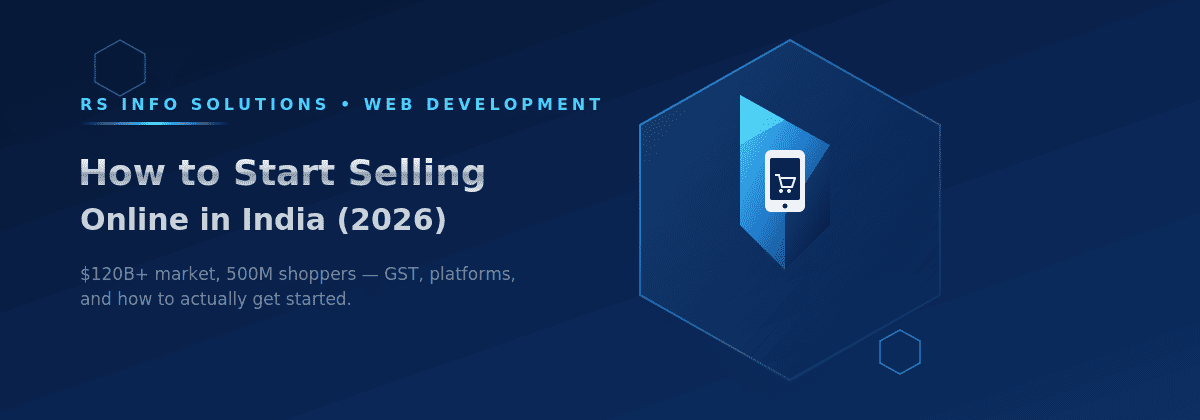
India's e-commerce market has crossed $120 billion in 2026, growing at 19–22% annually, with somewhere between 350 and 500 million active online shoppers depending on which measure you use. What makes this moment genuinely different for a small business owner isn't just the size of the number — it's where the growth is actually coming from. Roughly 62% of new online shoppers now come from Tier 2 and Tier 3 cities, not the metros that used to dominate India's e-commerce story. If your customer base lives anywhere outside the biggest cities, the market has moved toward you, not away from you.
Mobile Isn't Optional — It's Where the Transaction Actually Happens
Mobile commerce now accounts for somewhere between 70% and 82% of all e-commerce transactions in India, depending on the category. Within mobile, the gap between app and mobile-web experience is significant: app-based commerce converts roughly 3.2 times better than mobile web. For a small business deciding where to invest first, this is a clear signal — a mobile-optimized experience isn't a nice-to-have feature, it's the primary channel your revenue will actually flow through.
Step 1: Get Your Legal and Tax Registrations in Order First
This is the step most first-time online sellers underestimate, and it isn't optional. GST registration is mandatory the moment you sell through an e-commerce platform — regardless of your turnover, unlike offline businesses that only need to register past a turnover threshold. If you plan to sell on Amazon, Flipkart, Myntra, or your own website, GST registration needs to happen before you list your first product. Full details are in our GST Registration Checklist for New Businesses.
Alongside GST, most serious online sellers also benefit from MSME (Udyam) registration — it's free, takes minutes, and several marketplace platforms offer preferential terms or reduced fees to Udyam-registered sellers.
Step 2: Choose Your Selling Model
- Marketplace selling (Amazon, Flipkart, Meesho) — fastest way to reach existing buyer traffic, with built-in logistics and payment handling, but with platform commissions and less control over branding and customer relationships.
- Your own D2C website — full control over branding, pricing, and customer data, and no marketplace commission — but you're responsible for driving your own traffic. India now has over 800 D2C brands crossing ₹100 crore in annual revenue, proof this model scales seriously when built well.
- Quick commerce (Blinkit, Swiggy Instamart, Zepto) — relevant specifically for grocery, FMCG, and pharmacy categories, where quick commerce conversion rates run roughly 8 times higher than traditional e-commerce due to the immediate-need nature of the purchase.
Most serious sellers eventually run more than one of these simultaneously — a D2C site for margin and brand control, alongside a marketplace presence for reach.
Step 3: Build a Website That Can Actually Handle Transactions
If you're building your own D2C store, Shopify has become the platform of choice for Indian e-commerce sellers, largely because it handles payments, inventory, and mobile checkout natively rather than requiring you to configure each piece separately. For deeper platform trade-offs, see our Website Development Cost guide, which breaks down realistic e-commerce build costs by complexity.
Whatever platform you choose, a small number of technical priorities matter disproportionately for e-commerce specifically:
- Mobile checkout speed — given that mobile drives the large majority of transactions, a slow or clunky mobile checkout is a direct revenue leak.
- UPI as the default payment option — UPI now holds roughly 73% share of e-commerce payments in India, while Cash on Delivery has dropped from 45% to just 18% over the past few years. A checkout that doesn't make UPI the obvious, fastest option is fighting consumer habit rather than working with it.
- Reviews and social proof near the buy button — with cart abandonment sitting around 68% industry-wide, visible reviews and clear return/shipping policy information at the decision point are among the most effective, low-cost levers to reduce it.
Step 4: Understand Where the Payment Landscape Is Heading
Beyond UPI's dominance, Buy Now Pay Later (BNPL) is a genuine and growing factor — orders using BNPL options show roughly 12% higher average order values, particularly among younger shoppers. Offering a BNPL option at checkout, even through a third-party integration, is increasingly a realistic way to lift average order value rather than a niche feature reserved for large retailers.
Step 5: Know Your Audience — Younger and More Mobile-Native Than You Might Assume
Gen Z now accounts for 40–45% of India's total online shoppers, and contributes to nearly half of all new orders. This audience shops in a fundamentally mobile-first, social-media-influenced way — discovering products through short-form video and social content rather than a traditional search-driven journey. If your marketing strategy is built primarily around a desktop-era customer journey, it's increasingly out of step with who's actually driving new order growth. Our Social Media Marketing Trends guide covers how this shift should shape your content strategy specifically.
Fastest-Growing Categories Worth Knowing About
- Grocery and FMCG — growing at roughly 38% year-on-year, the fastest of any major category, driven almost entirely by quick commerce adoption.
- Health and pharmaceuticals — growing around 31% year-on-year, with platforms making medicine and supplement ordering as routine as any other online purchase.
If your business sits anywhere near these categories, the growth curve is currently steeper than the broader e-commerce average.
5 Frequently Asked Questions About Starting to Sell Online in India
1. Do I need GST registration to sell on Amazon or Flipkart?
Yes, GST registration is mandatory to sell on any e-commerce platform in India, regardless of your turnover — this is one of the few cases where the usual turnover threshold doesn't apply. This needs to be sorted before you can list your first product.
2. Should I sell through a marketplace, my own website, or both?
Most serious sellers eventually run both. Marketplaces give you faster access to existing buyer traffic with less upfront marketing effort; your own D2C website gives you better margins, full brand control, and direct customer data, but requires you to drive your own traffic.
3. How important is mobile optimization for an e-commerce site in India?
Extremely — mobile accounts for 70–82% of all e-commerce transactions in India, and app-based commerce converts roughly 3.2 times better than mobile web. Any e-commerce investment should prioritize the mobile and app checkout experience first.
4. What's the biggest reason online stores lose sales in India?
Cart abandonment, which sits around 68% industry-wide. The most effective fixes are usually straightforward: fast, UPI-first checkout, visible reviews near the buy button, and clear shipping and return policy information at the point of decision.
5. Is quick commerce relevant for my business, or only for large grocery platforms?
It's most relevant specifically for grocery, FMCG, and pharmacy categories, where immediate need drives purchase decisions — quick commerce conversion rates run roughly 8 times higher than traditional e-commerce in these categories. For most other product categories, standard e-commerce or marketplace selling remains the more relevant model.
How RS Info Solutions Can Help
Starting to sell online in India involves more coordinated moving parts than most first-time sellers expect — GST and MSME registration, a mobile-optimized store that actually converts, UPI-first checkout, and a marketing strategy built around how Indian shoppers actually discover products in 2026. We handle this as one connected process: compliance registration, e-commerce website development, and the digital marketing strategy to bring in your first customers, so nothing sits blocked waiting on something else.
Ready to start selling online? Get a free consultation with our e-commerce team.